22 October
Introduction: Understanding U-Cut vs. V-Cut Hairstyles
Ask any stylist what customers request most for long hair and the answer is usually a trim that “just looks neat.” The U cut hair and the V cut hair are the two main types of haircuts that alter the back of the hair and make long hair appear fresher without taking away length. There are definitely minor differences between the two that are not noticeable on paper but become very noticeable once your hair is in motion. This Blog explains how each cut looks, who it flatters and how to decide before visiting a salon franchise in India.
What is a U Cut Haircut?
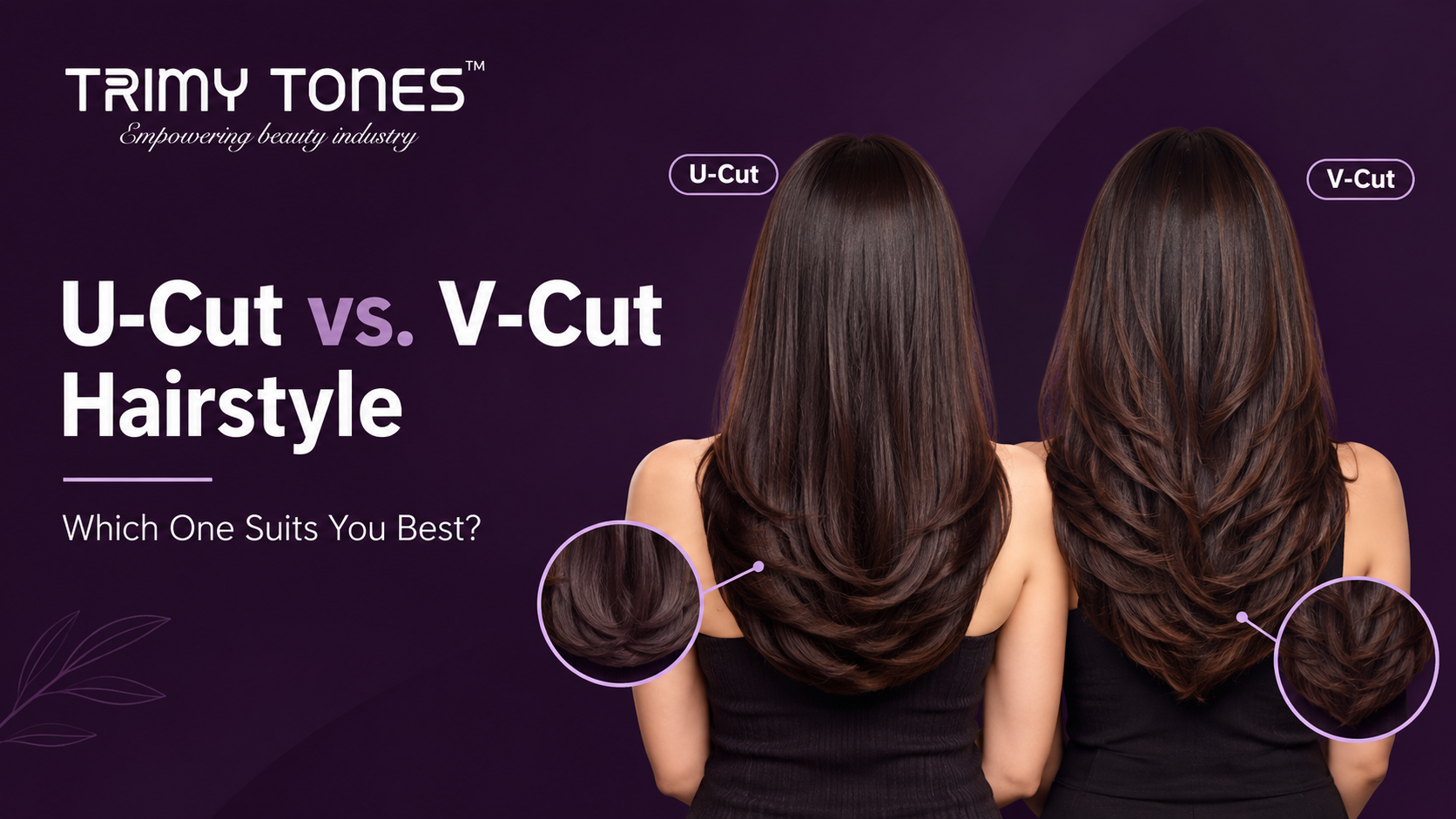
A U cut haircut trims the back of the hair into a soft, rounded curve. The longest strands sit at the sides and the center blends in gently so the hemline looks like the letter U. Many people also call it a U shaped haircut or a U shape hair cut.
Because the ends are even and curved, U cut hair looks full and balanced. It works well for people who want to keep maximum length and need only a tidy finish. A deep U haircut takes the curve a little further. The sides stay longer and the center is cut noticeably higher. This provides more movement and doesn't change the overall length of the dress much.
What Is a V Cut Haircut?
A V cut haircut shapes the back into a point. It has a center that's longer than the sides which slope up to meet in the center at the hairline to create a V shape. V shape hair cut can be steep or shallow and a trained stylist can determine the best angle for your face shape.
A forward pointing hem adds length to hair and adds dimension. A long forward pointed hem also gives hair movement with a visible line down the back. That is why a V cut hairstyle photographs well and tends to stand out in braids, ponytails and open styles.
What is the difference between U Cut and V Cut ?
A U cut gives a rounded and even finish, while a V cut gives a pointed and angular one. Everything else follows from that. The table below shows how they compare in daily wear.
|
Feature |
U Cut |
V Cut |
|
Back shape |
Rounded curve |
Pointed center |
|
Overall look |
Soft and uniform |
Sharp and layered |
|
Length lost |
Very little |
Slightly more at the sides |
|
Maintenance |
Easier to keep neat |
Needs regular tidying |
|
Works best with |
Straight and wavy hair |
Straight and thick hair |
Neither one is better in general. The right pick depends on your hair texture, your styling routine and how defined you want the back of your hair to look.
Which Haircut Suits Hair Type?
If your hair is thin or fine, the U-cut hairstyle is usually the safer choice. Keeping the ends even avoids thin, tapered ends that can make thin hair look sparse. Wavy and curly hair also settles well into a U shaped haircut because the curves blends with natural bounce.
Thick and straight hair tends to show a V shape hair cut more clearly. The pointed hem holds its line and adds layers that reduce weight at the back. If your hair feels heavy by evening, the V cut can feel lighter since the sides shorten gradually.
Face shape matters less than people think because the cut sits at the back. What matters more is how often you wear your hair open and whether you like a defined shape when it is tied up. A U cut is often preferred by a person with a day-to-day ponytail habit, since the ends of the hair are already nicely shaped. A person with a loose hanging hair may feel the visual tip of a V cut is better.
How to Explain the Cut to Your Stylist
Photos help more than names because stylists may use the terms differently. Bring two or three images and say how much length you are willing to lose. Mention if you want the curve or the point to be mild or strong. The same words can mean different depths of cut. Teams that work on hair care services usually check your hair texture and confirm the shape before chopping off the hair.
Trimy Tones Salon believes that your haircut should be according to the latest trend and should complement you. This means taking the time to learn a client’s personal preferences before cutting their hair.
Final Thoughts
Whether to go with a U cut or a V cut comes down to how you wear your hair and how much upkeep you want to have. The U cut makes for a softer and less defined finish. Whereas, the V cut provides a cleaner and more prominent shape. Book a short consultation and see if a stylist thinks you can pull off a V cut. Trimy Tones will help find the right hair shape for your lifestyle.
Frequently Asked Questions
1. Is a U cut better than a V cut?
Neither is better overall. An even rounded finish is achieved with a U cut. This is easier to maintain as well. A V cut gives a sharper look with layers. However, this requires more regular trims. Know your hair and your lifestyle. The choice should be based upon these factors and not popularity.
2. Which cut keeps more length?
When hair is cut with a U-shape, there is usually more length retained because the ends are evenly cut. With a V-shape cut, there is a potential loss of length because the hair slopes up to meet a point. To lose the least amount of length, ask for a shallow curve or an angle.
3. Does a V cut hairstyle suit thin hair?
It can but needs care. A steep point may make thin hair look sparse at the ends. A softer V with light layering works better. Many stylists recommend a U cut for very fine hair because the even hem looks fuller.
4. How often should I trim U cut hair or a V cut?
U cut hair holds its shape for about two to three months. A V cut shows growth sooner and usually needs a tidy every six to eight weeks. Individual hair growth varies so your stylist can suggest a schedule after seeing your hair.
5. Can I switch from a V cut to a U cut later?
Yes. Moving from a V to a U is simple since the longer center can be trimmed to match the sides. Going from a U to a V takes more length off the sides so plan for that before deciding